Multivalent ligands regulate dimensional engineering for inverted perovskite solar modules
Xiaoming Chang, Yanping Liu, Yue Ping, Nan Wu, Tinghuan Yang, Chenqing Tian, Zhaoheng Ling, Badri Vishal, Anil Reddy Pininti, Jong Bin Park, Sang Young Jeong, Yan Qin, Wing Tung Hui, Fion Sze Yan Yeung, Yu-Ying Yang, Hailiang Liao, Adi Prasetio, Furkan H Isikgor, Mingjie He, Drajad Satrio Utomo, Rongbo Wang, Kui Zhao, Mario Lanza, Han Young Woo, Martin Heeney, Stefaan De Wolf, Yen-Hung Lin, Leonidas Tsetseris, Randi Azmi, Thomas D Anthopoulos
Science
2026
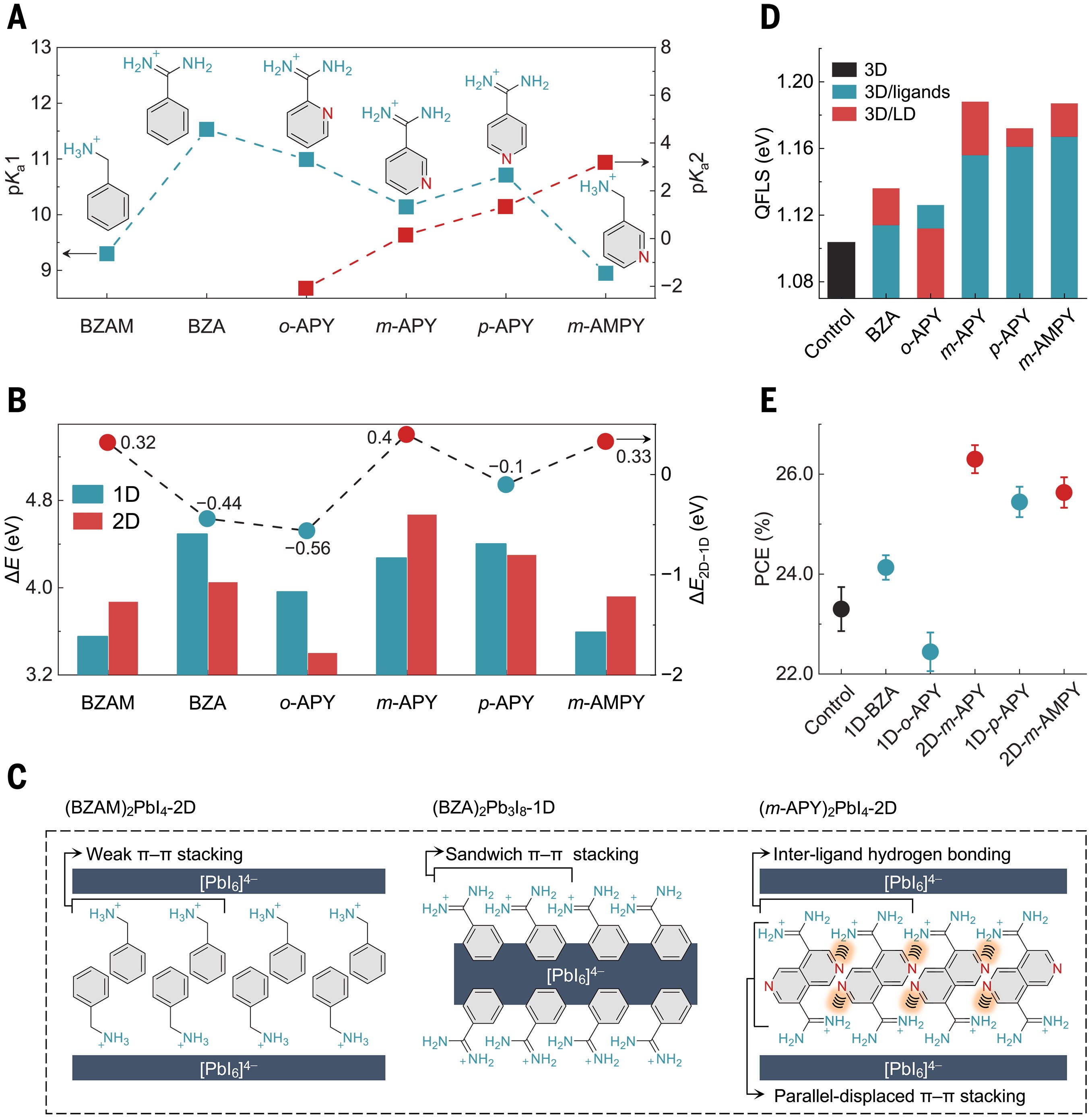
Multivalent, resonance-stabilized amidinium ligands enable stronger chemical coordination and reduced deprotonation compared with conventional monovalent ammonium ligands in low-dimensional perovskites. Here, we introduce a controllable one- to two-dimensional (1D-to-2D) structural transition strategy by systematically tuning ligand conformation, thereby modulating hydrogen bonding, π–π stacking, and basicity to elucidate the relationship between molecular structure, interfacial interactions, and resulting dimensionality. The 1D-amidinium perovskite structure, with its pronounced geometric anisotropy, impedes uniform surface coverage and defect passivation. In contrast, the 2D-amidinium perovskite forms a continuous, homogeneous interfacial layer, enabling more effective defect passivation and favorable energy-level alignment. With dimensionality control, inverted 3D/2D-amidinium perovskite solar cells deliver 25.4% power conversion efficiency (1.1 square centimeters, steady-state certified) and maintain >95% of their initial efficiency after 1100 hours of continuous 1-sun operation at 85°C.