Pillar-like Macrocycle Reversibly Self-Assembled from a Molecular Thermally Activated Delayed Fluorescence Emitter Based on B ← N Dative Bonds with Intriguing Fluorescence
Yanru Li, Jiawei Chen, Wenyu Jiao, Jianeng Ma, Yongsheng Chen, Jun Xu, Zhiqiang Liang, Shaoqiang Dong, Xing Chen, Martin Heeney, Zhuping Fei
Journal of the American Chemical Society
2025
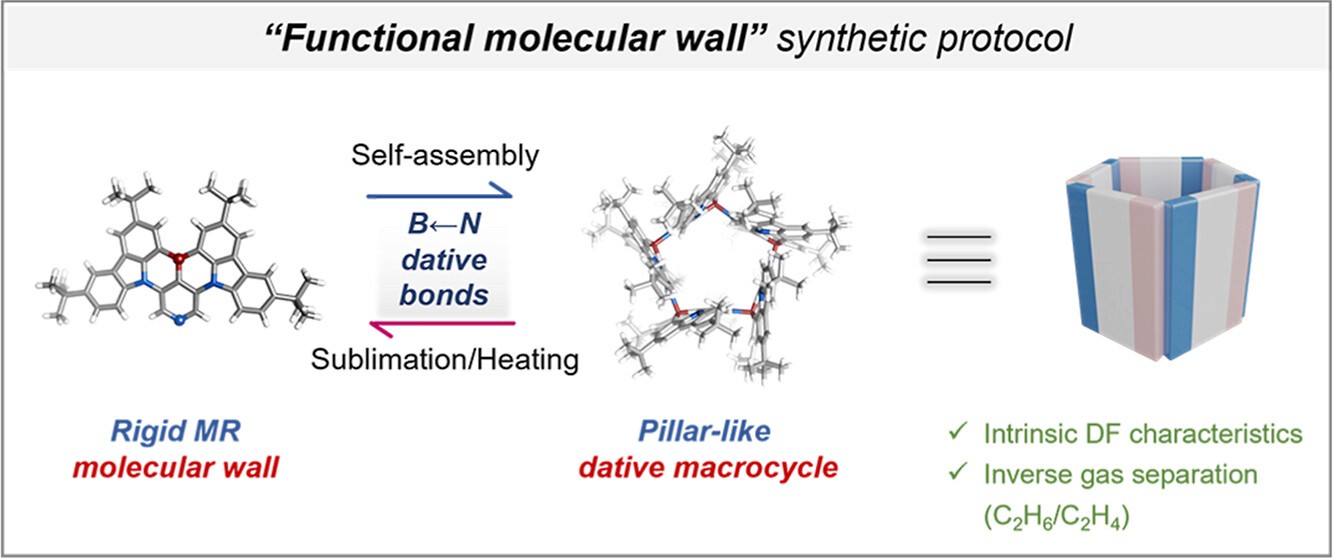
Incorporating boron atoms into organic macrocycles imparts unique chemical, electronic, and optical properties. The concept of making use of dative boron–nitrogen (B ← N) bonds for the construction of macrocycles has been proposed, but very few examples have been prepared with functional structures, much less pillar-like and other prismatic macrocycles, and their various functionalities have not been fully exploited. Here, we introduce a “functional molecular wall” synthetic protocol based on the self-assembly characteristics of B ← N dative bonds to construct highly symmetrical macrocycles, forming a quasi-pentagonal-shaped macrocycle (named [5]pyBN-p) with a pillar-like structure. Single-crystal analysis confirmed that its structure exhibited a 5-fold symmetric crown-shaped cavity with a diameter of approximately 9.65 Å, forming four sets of three-dimensional channel stacking structures. In solution, thermal cycling between heating and cooling allows for a fast and fully reversible conversion between monomer pyBN-p and pentameric macrocycle [5]pyBN-p. The resultant macrocycle [5]pyBN-p exhibited delayed fluorescence (DF) property and high photoluminescence quantum yield in the solid state. Notably, the supramolecular aggregates of macrocycle [5]pyBN-p possessed permanent porosity and showed an efficient C2H6/C2H4 inverse separation capacity. This work highlights a new molecular design strategy for B ← N-containing macrocycles, enriching the family of molecular species and expanding new avenues for their applications.