Resonant X-Ray Diffraction of Conjugated Polymers at the Selenium K-Edge
Guillaume Freychet, Nigel Kirby, Matthew Gebert, Yun‐Hi Kim, Qiao He, Martin Heeney, Christopher R McNeill
Macromolecular Rapid Communications
2026
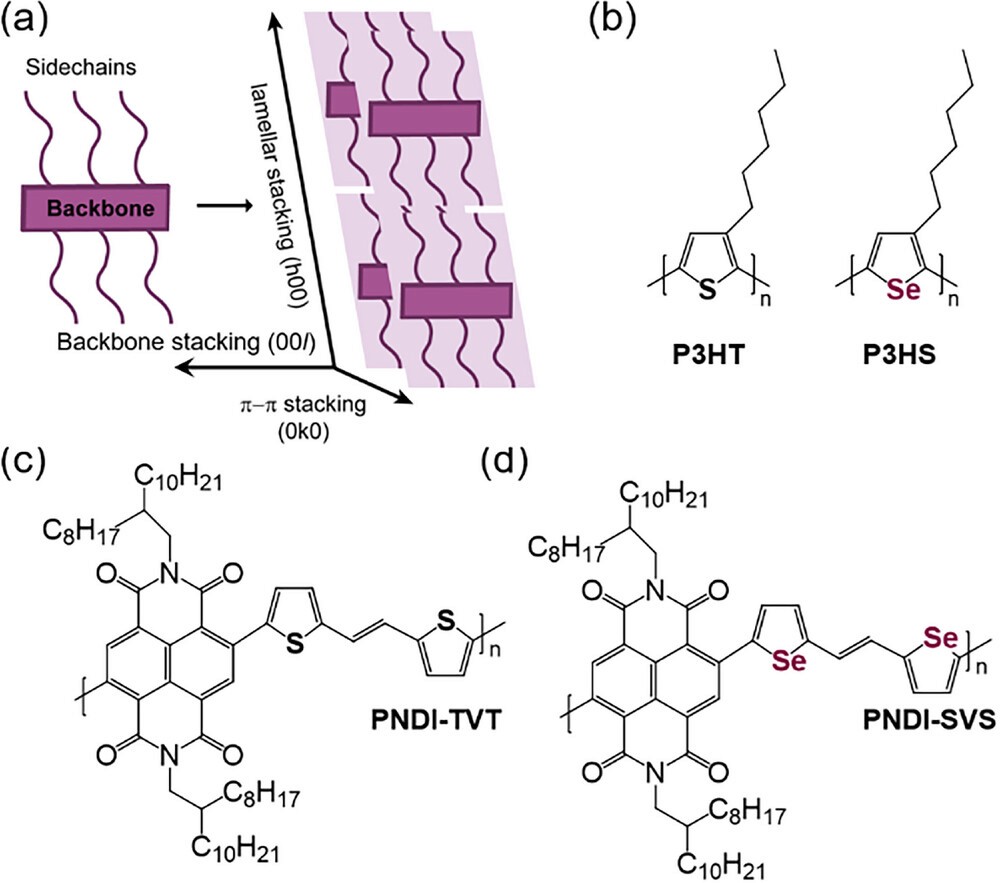
Conjugated polymers exhibit a rich microstructure with a degree of order between amorphous and crystalline. The performance of semiconductor devices based on conjugated polymers is strongly influenced by this microstructure yet it is difficult to fully characterize. This work investigates the potential of performing resonant diffraction at the selenium K-edge to reveal new microstructural information about conjugated polymer thin films. By studying the variation of diffraction intensity as the X-ray energy is varied across an absorption edge, resonant diffraction, also known as anomalous scattering, can provide new information about molecular packing within the unit cell. With its absorption edge at 12.66 keV, corresponding to a wavelength of ∼ 1 Å, selenium K-edge measurements allow for peaks corresponding to the smallest crystalline spacings (e.g. π--π stacking) to be studied. Two selenium-containing polymers, namely poly(3-hexylselenophene) (P3HS) and poly[(E)-2,7-bis(2-decyltetradecyl)-4-methyl-9-(5-(2-(5-methylselenophen-2-yl)vinyl)selenophen-2-yl)benzo[lmn][3,8] phenanthroline-1,3,6,8(2H,7H)-tetraone] (PNDI-SVS, a naphthalene diimide and selenophene-vinylene-selenophene-based copolymer) are studied. Comparison is made to measurements performed at the sulfur K-edge by studying the thiophene analog of PNDI-SVS. While less pronounced than at the sulfur K-edge, variations in diffraction intensity and anisotropic diffraction at the selenium K-edge are observed, demonstrating the potential for interrogating π--π stacking peaks that may assist with the refining of structural models.