Selective Charge Extraction Allows Fast Photomultiplication and Imaging in Rigid and Ultra‐Flexible SWIR Organic Photodiodes
Matilde Brunetta, Zhuoran Qiao, Davide Nodari, Kosei Sasaki, Francesco Furlan, Martina Rimmele, Hongki Kim, Hongting Chen, Yusaku Tagawa, Adam Marsh, Rushil Vasant, Sang Do, Xabier Rodríguez‐Martínez, Anirudh Sharma, Christos L Chochos, Jaime Martin, Martin Heeney, Koen Vandewal, Derya Baran, Thuc‐Quyen Nguyen, Bob C Schroeder, Takao Someya, Tomoyuki Yokota, Nicola Gasparini
Advanced Energy Materials
2026
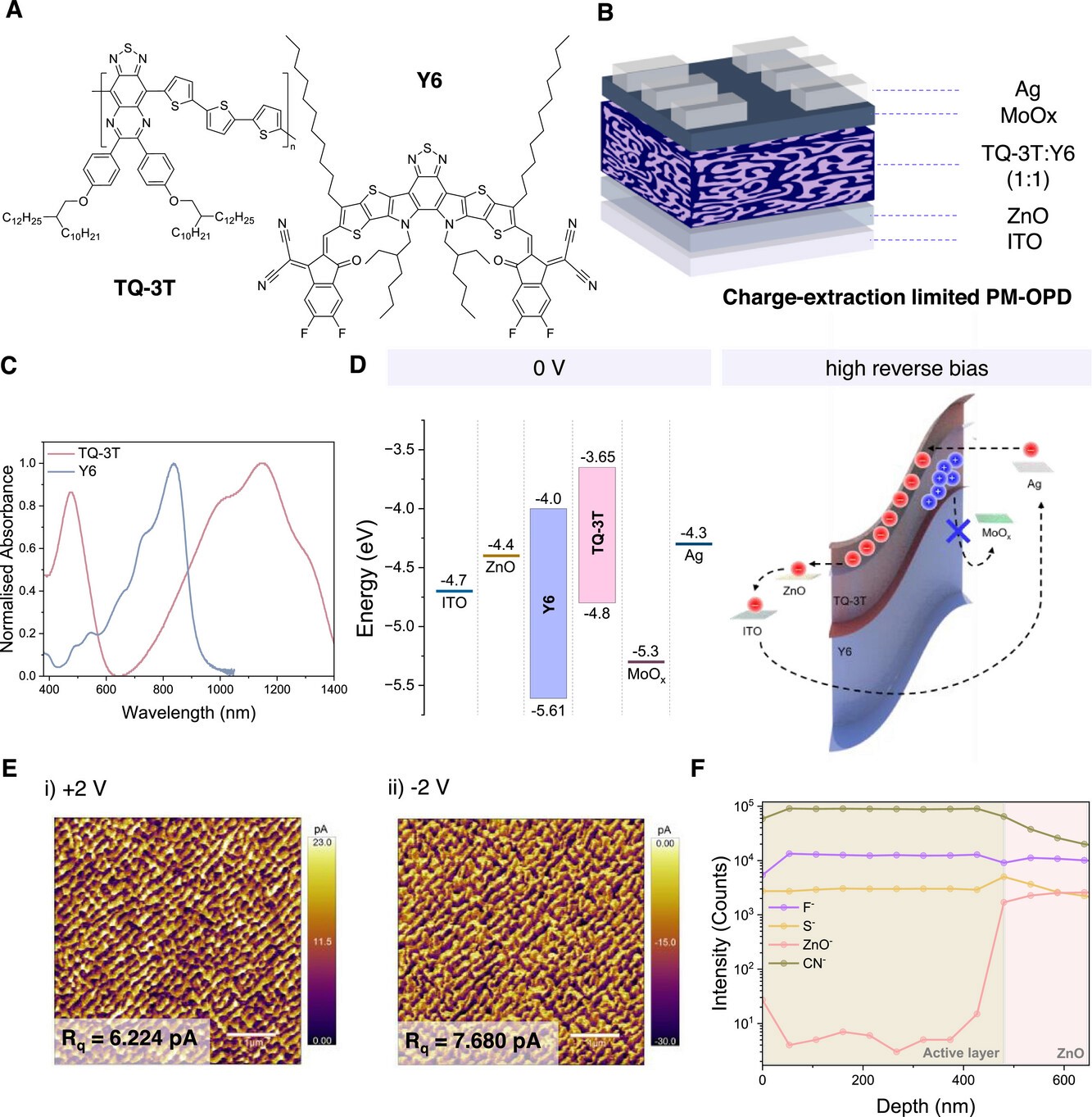
Expanding the absorption window of organic photodiodes (OPDs) over the 1000 nm benchmark is essential for bioimaging and medical applications. However, progressing into this wavelength range has proven to be a challenging task due to the scarcity of near-infrared (NIR) semiconducting polymers and small molecules with suitable energy alignment and processability. OPDs based on low-bandgap donor polymers generally present low responsivities and, therefore, low detectivities in the NIR. Photomultiplication (PM) has been introduced as a promising strategy to increase the external quantum efficiency (EQE) above unity. However, its application has been mainly limited to OPDs operating in the visible range and with response speeds within the millisecond range. In this work, we present PM-OPDs utilizing an equal donor (D):acceptor (A) ratio in the bulk heterojunction photoactive layer. This changes the common understanding of PM-OPDs, in which heavily unbalanced D:A ratios were needed to impose trap-assisted charge tunnelling injection at high reverse bias. Here, the NIR polymer TQ-3T was used with nonfullerene acceptor Y6. PM-OPDs with an EQE of above 1100% at 840 nm and 31% at 1100 nm at -10 V, and fast response times of 73 µs were achieved. We also demonstrate ultrathin (<3 µm) flexible PM-OPDs based on the TQ-3T:Y6 blend without any drop in performance compared to rigid samples with a stable dark current density after 1000 bending cycles. Finally, we demonstrate an application of the PM-OPD as a flexible and pulse oximeter and large-area image sensor for accurate vein recognition.