The Dynamics of Interfacial Trap States in High‐Detectivity Near‐Infrared Photomultiplication Organic Photodetectors
Marie Houot, Zhuoran Qiao, Beier Hu, Davide Nodari, Francesco Furlan, Filip Aniés, Yicheng Yang, Martin Heeney, Artem A Bakulin, Nicola Gasparini
Advanced Functional Materials
2025
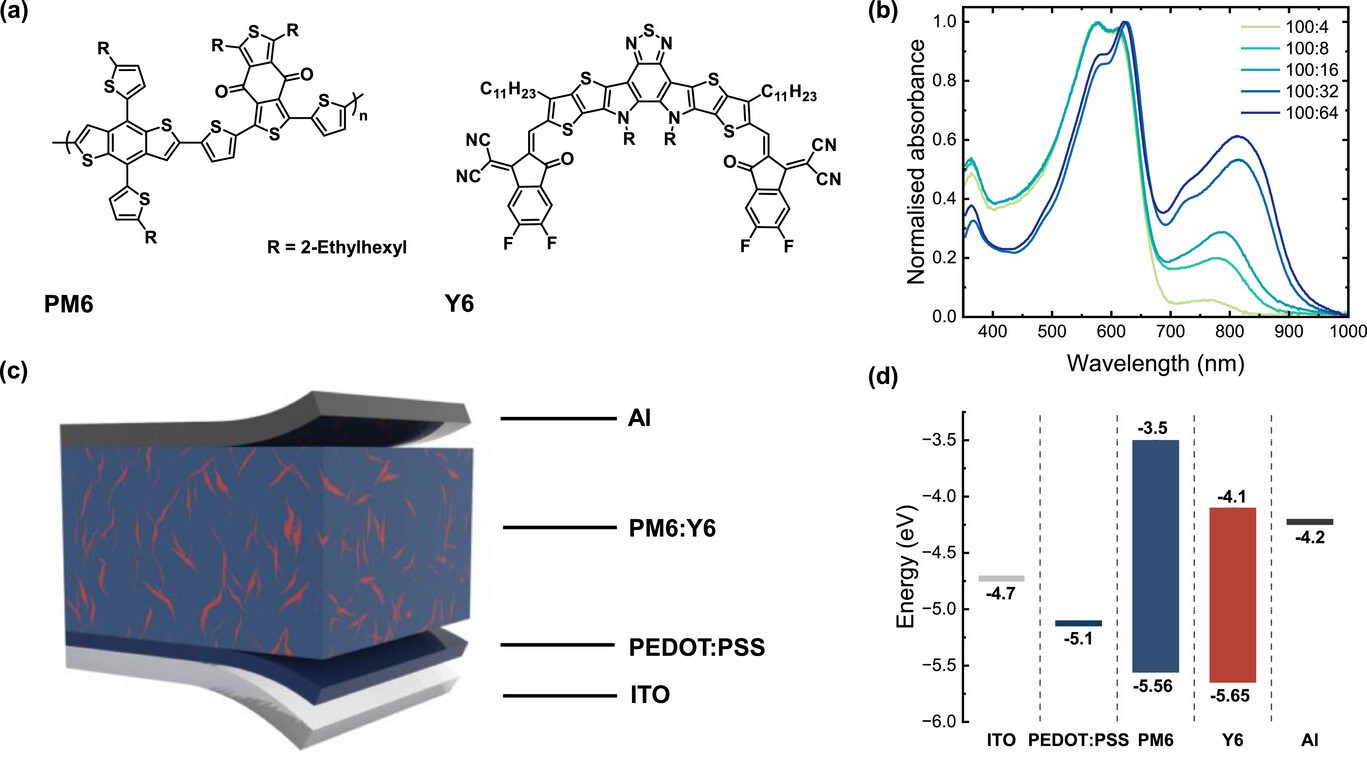
The record-high responsivity of photomultiplication organic photodetectors (PM OPDs) makes them an attractive solution for biometric monitoring and imaging applications. Photomultiplication is achieved through charge injection at high reverse bias via optical population of electronic trap states. However, the carrier dynamics governing charge generation have not been studied in operational devices, due to a lack of direct probes for observing low concentrations of trapped carriers. In this work, a novel set of spectroscopic approaches is applied to elucidate the dynamics of carrier trapping in a new high-performance near-infrared PM OPD with specific detectivity of 5.7 × 10¹² Jones and external quantum efficiency values of 3500% under −10 V. Trap selective spectroscopical techniques reveal how the optimised ratio of donor polymer and non-fullerene acceptor of 100:16 by weight features the highest trap density at the active layer/electrode interface. By tracking the population of trapped electrons, a relatively fast build-up (500 ns) is found and a much slower depletion of trap carrier density (100 µs to ms). The applicability of the devices is demonstrated by accurate determination of the cardiac cycle, and the PM effect is reproduced by using a different donor polymer, showcasing comparable device performances.