Counterion‐Controlled Photocatalytic Doping of Organic Semiconductors
Tiefeng Liu, Zesheng Liu, Ihor Sahalianov, Qiao He, Sang Young Jeong, Huotian Zhang, Qifan Li, Chi‐Yuan Yang, Junpeng Ji, Lize Bynens, Wouter Maes, Feng Gao, Han Young Woo, Martin Heeney, Glib Baryshnikov, Mats Fahlman, Simone Fabiano
Advanced Materials
2026
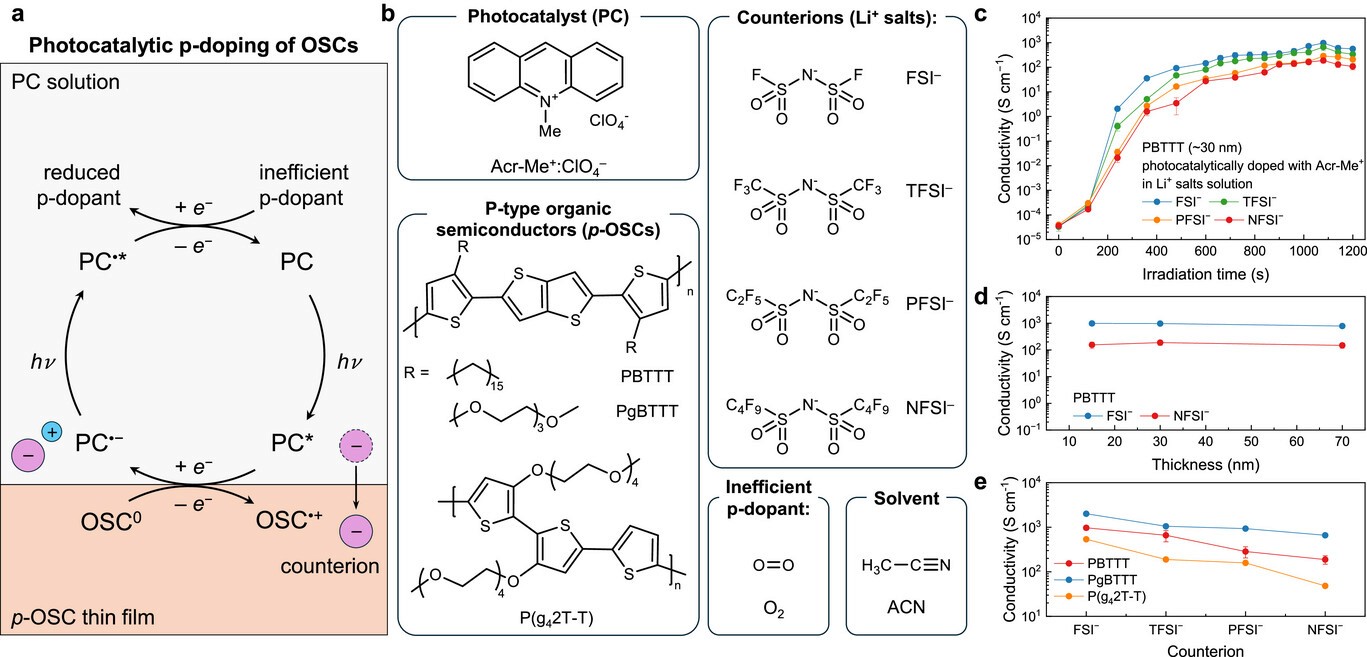
Photocatalytic doping is a versatile and potentially sustainable strategy to control charge accumulation and transport in organic semiconductors (OSCs). In this process, light-activated photocatalysts (PCs) act as electron shuttles, oxidizing or reducing OSCs under mild conditions, while redox-inert salts supply counterions to stabilize the resulting charges. Although the energetics of PC/OSC systems are well studied, the influence of counterions has not yet been systematically examined. Here, we show that counterion size and interaction with the PC critically govern photocatalytic doping efficiency. Using acridinium-based PCs with lithium salts of varying anion size, we find that smaller anions such as bis(fluorosulfonyl)imide (FSI−) suppress PC aggregation, enhance electron transfer, and yield conductivities up to 2000 S cm−1 in PBTTT derivatives. Spectroscopic and density functional theory (DFT) analyses show that FSI− disrupts Acr-Me+ stacking and increases its electron affinity by ∼0.1 eV relative to bulkier anions. These results uncover counterion size as a key design parameter for optimizing photocatalytic doping in OSCs.