Short‐Wavelength Infrared Imaging with Organic Photodetectors Based on Non‐Fullerene Acceptors with Detection above 1200 nm
Zhuoran Qiao, Sandeep Sharma, Yakun He, Marie Houot, Kun‐Han Lin, Davide Nodari, Filip Aniés, Matilde Brunetta, Patipan Sukpoonprom, Eunyoung Hong, Edoardo Angela, Zian Wang, Pichaya Pattanasattayavong, Martyn A McLachlan, Artem Bakulin, Denis Andrienko, Frédéric Laquai, Martin Heeney, Nicola Gasparini
Advanced Materials
2026
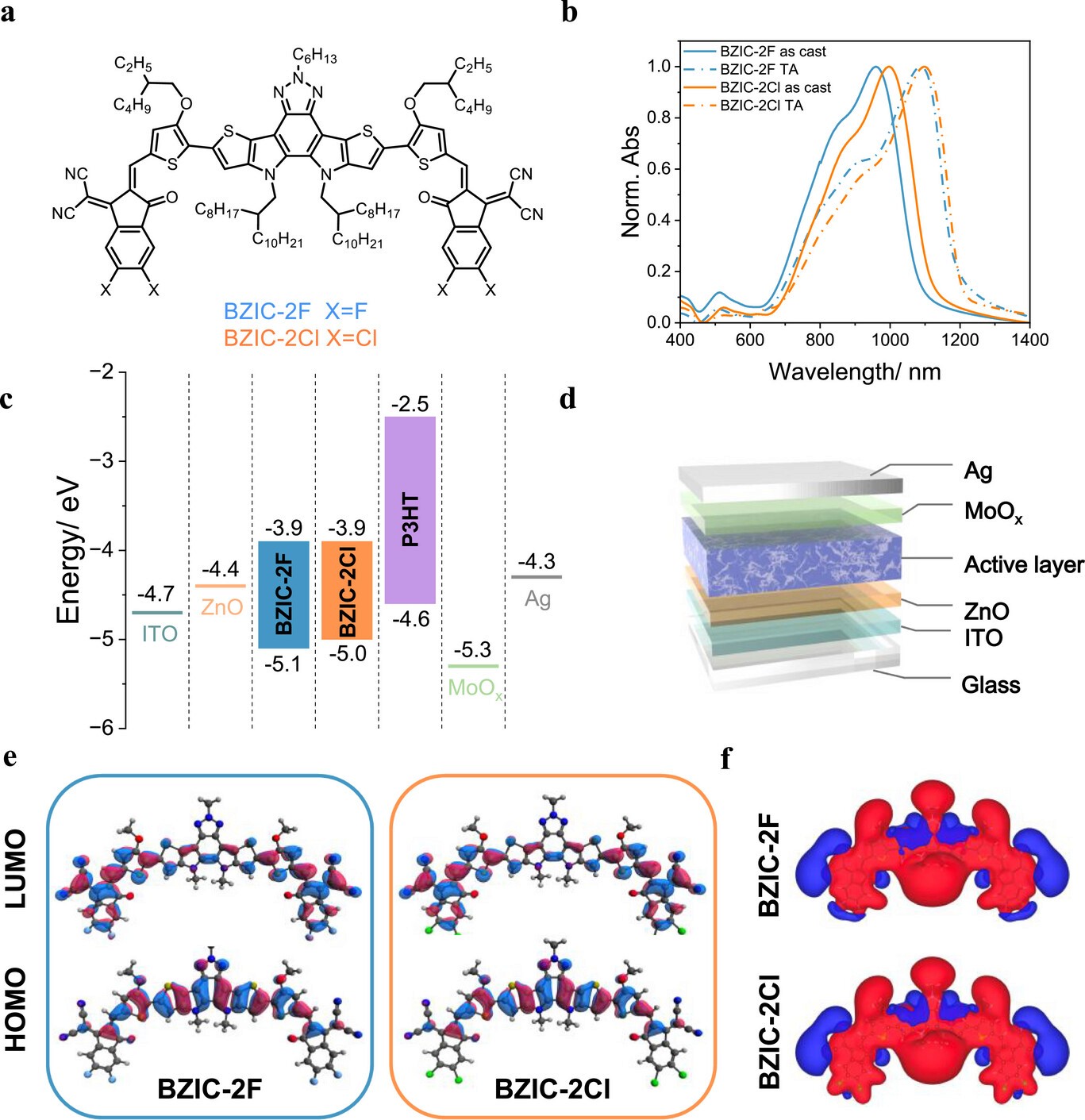
Organic photodetectors (OPDs) have emerged as promising candidates for next-generation light-detecting technologies. Compared to traditional inorganic photodetectors (e.g. silicon and indium gallium arsenide), OPDs offer advantages including lower fabrication cost, intrinsic mechanical flexibility, and tunable detection range. However, their performance still lags behind that of traditional detectors, particularly in the near-infrared region. In this work, two low band gap non-fullerene acceptors, BZIC-2F and BZIC-2Cl are synthesized, both exhibiting absorption onsets beyond 1200 nm. OPDs based on BZIC-2F deliver superior performance when blended with the low-cost donor P3HT, achieving spectral responsivity values of 0.49 A W−1 (1010 nm under −2 V) and a specific detectivity of 1.30 × 10¹² Jones, outperforming benchmark commercial silicon detectors in the shortwave infrared (SWIR) range, while maintaining stable photoresponse over 3 million on/off illumination cycles. Furthermore, a prototype blade-coated active-matrix imager is fabricated in air on an amorphous silicon backplane. The imager exhibits a broadband light detection range spanning from visible to SWIR, enabling practical applications such as faint infrared light imaging, semiconductor wafer inspection, LiDAR light detection, and banknote verification. Combined with detailed materials cost analysis, this work represents the first demonstration of an integrated active-matrix imager employing a fully organic semiconductor photoactive layer capable of high-speed SWIR imaging, highlighting its promise for a scalable and cost-effective next-generation SWIR photodetector.