n‐Type Polymer Radio Frequency Rectifiers Operating at 18.5 GHz
Lazaros Panagiotidis, Filip Aniés, Yiyang Yu, Mohammed Ghadiyali, Hendrik Faber, Zhanibek Bizak, Youssef Kabri, Pavlos Tzourmpakis, Suman Mandal, Linqu Luo, Temur Maksudov, Mohamad Insan Nugraha, Harold F Mazo‐Mantilla, Patrice Vanelle, Julie Broggi, Khaled N Salama, Udo Schwingenschlögl, Martin Heeney, Atif Shamim, Thomas D Anthopoulos
Advanced Materials
2026
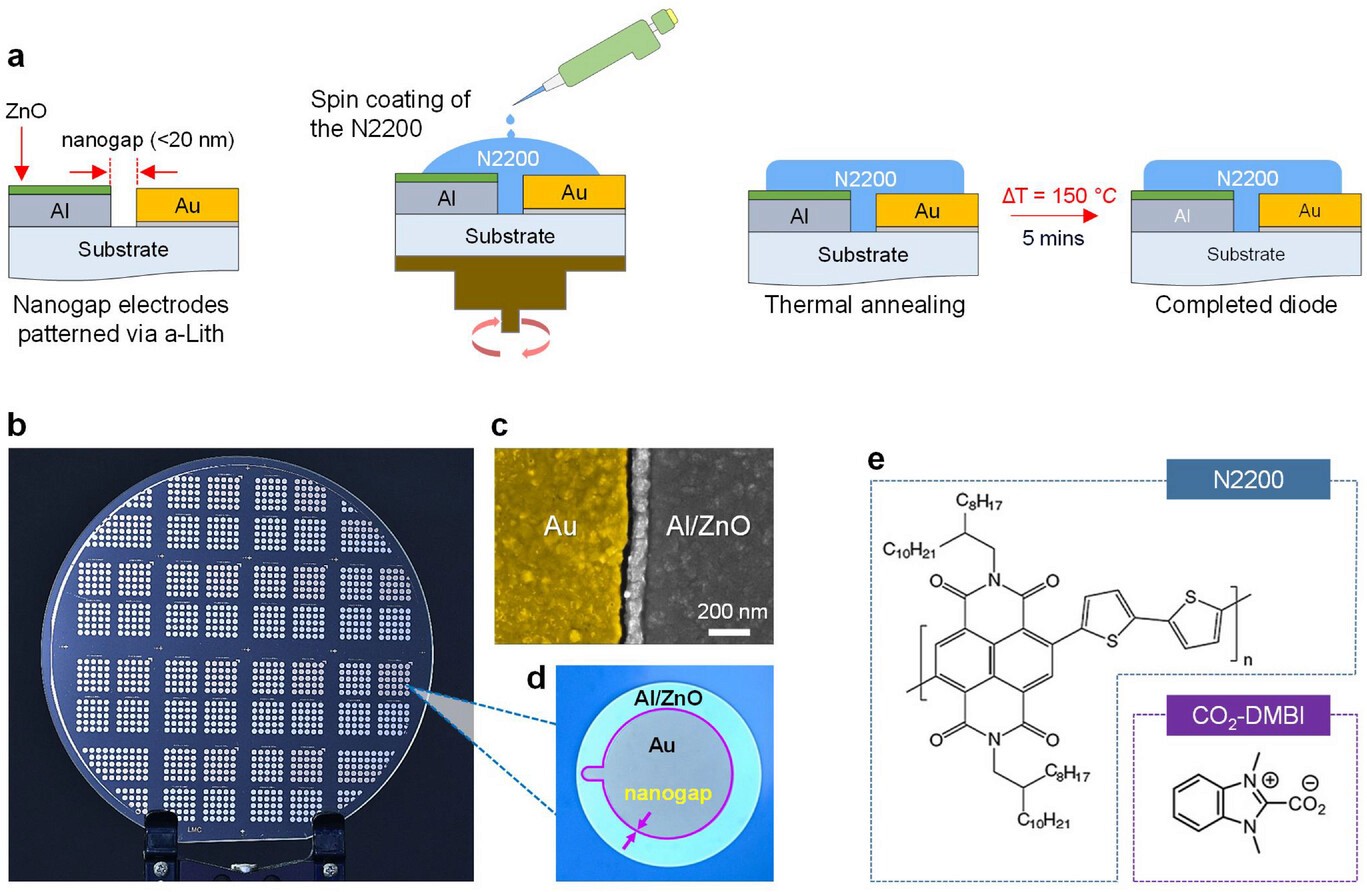
As advancements in artificial intelligence, the Internet of Things (IoT), and telecommunication technologies continue to accelerate, the demand for cheaper radiofrequency (RF) electronics increases. However, developing devices that meet the stringent manufacturing and performance criteria for RF applications remains a significant challenge. Here, we demonstrate organic polymeric RF Schottky diodes and rectifier circuits that can operate up to 18.5 GHz, making them the fastest organic devices reported to date. The diodes feature the molecularly n-doped polymer, namely N2200, deposited atop self-aligned coplanar asymmetric nanogap electrodes (sub-20-nm nanogaps). The coplanar architecture reduces parasitic capacitances, while the engineered electron-injecting contacts, in synergy with the n-doped polymer, help decrease the contact resistance and boost the device's overall performance. The polymer Schottky diodes exhibit a low turn-on voltage of ≈0.15 V, a high current rectification ratio exceeding 105, and an ultra-low capacitance of ≈2 pF. RF rectifier circuits featuring the polymer Schottky diodes yield a maximum output voltage (VPEAK) of 1.43 V and an extrinsic cut-off frequency of up to 18.5 GHz. The scalable manufacturing and unprecedented frequency response make these organic Schottky diodes a good candidate for applications in emerging RF electronics for wearables and the broader IoT device ecosystem.