Photophysics and Device Performance of a Pyran‐Bridged Pentacyclic A‐D‐A‐Type Non‐Fullerene Acceptor (NFA) in Organic Solar Cells
Wejdan Althobaiti, Yakun He, Sandeep Sharma, Julien Gorenflot, Wisnu Tantyo Hadmojo, Filip Aniés, Kun‐Han Lin, Maryam Alqurashi, José P Jurado, Shahidul Alam, Anirudh Sharma, Weimin Zhang, George T Harrison, Mohammed Bahaziq, Valentina Musteata, Shadi Fatayer, Derya Baran, Iain McCulloch, Thomas D Anthopoulos, Denis Andrienko, Martin Heeney, Frédéric Laquai
Advanced Optical Materials
2026
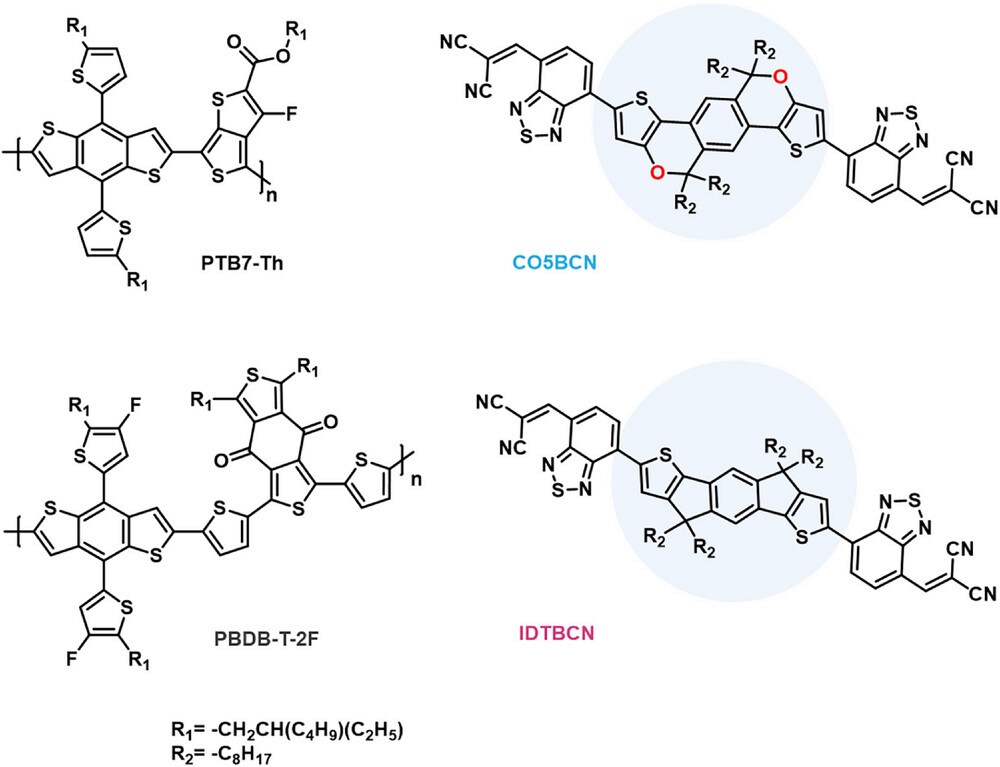
This work reports the synthesis and characterization of a novel non-fullerene acceptor (NFA), coded CO5BCN, featuring a pyran-bridged pentacyclic core. Initially selected based on in-silico computational screening for its high ionization energy, large quadrupole moment, strong oscillator strength, and low bandgap, CO5BCN was designed for optimal pairing with common donor materials in organic solar cells. Structurally related to the previously reported NFA coded IDTBCN, it contains a pentacyclic pyran-bridged donor core in its A-D-A-type structure. Despite this minor modification, CO5BCN showed markedly reduced device performance as the power conversion efficiency (PCE) decreased from 8.17% for PTB7-Th:IDTBCN to 4.01% for PTB7-Th:CO5BCN. The comparative study of the two NFAs using advanced transient optical and electro-optical spectroscopies, grazing incidence wide angle X-ray scattering, and computational tools finally revealed the origin of the lower performance of CO5BCN: increased solid state order yet reduced exciton diffusion length due to larger excited state reorganization energy limiting exciton quenching, dissociation, and charge generation, as well as increased charge carrier recombination. The results provide an improved understanding of the impact of the acceptor's molecular structure and its electronic landscape on the molecular and thin film properties, device photophysics, and ultimately performance of NFA-based organic solar cells.